
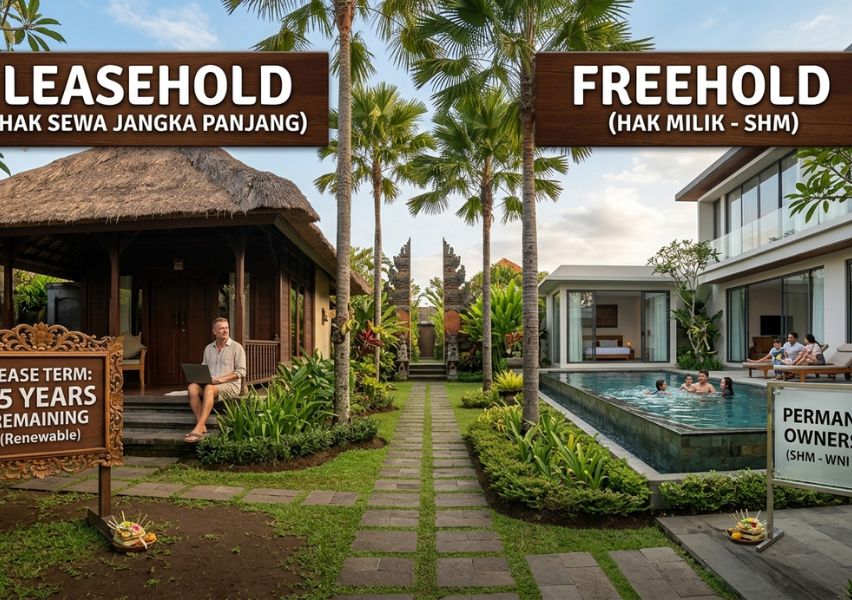
Investing in a villa in Bali remains an attractive option, both for hospitality businesses and long-term assets. However, before purchasing property in Bali, many prospective investors often encounter two important terms: leasehold and freehold.
For some, especially first-time buyers, the difference between the two remains confusing. Understanding the property ownership system is crucial before deciding to buy a villa in Bali. So, what exactly is the difference between leasehold and freehold? Which is more suitable for investment?
What is a Freehold Villa?
Freehold is a system of full property ownership with no time limit. Under this system, the owner retains full rights to the building and land. In Indonesia, freehold status is usually known as Hak Milik (SHM). Freehold owners have full control over the property, including:
Reselling
Inheriting the property
Renting
Renovating
Long-term use of the property
Due to the permanent nature of ownership, freehold villas in Bali are usually priced higher than leaseholds.
What is a Leasehold Villa?
Leasehold is a long-term lease of land or property for a specified period. Leasehold durations in Bali typically range from 20 years to decades, depending on the agreement. Under this system, the buyer has the right to use and manage the property for the duration of the contract.
After the lease expires, the right to use the property reverts to the landowner, unless the contract is extended. Because leasehold villas are not permanent ownership, prices are generally more affordable than freehold villas.
Differences Between Leasehold and Freehold in Bali
1. Ownership Status
Freehold: The owner has full rights to the land and building indefinitely. Leasehold: The owner only has the right to use the property for the agreed lease term.
2. Property Price
Freehold: Prices are usually higher because ownership is permanent. Leasehold: More affordable, often chosen by investors with a limited budget.
3. Long-Term Investment Potential
Freehold: More suitable for long-term investments and family inheritance assets. Leasehold: More suitable for investors focused on rental businesses and a return on investment within a specific period.
4. Return on Investment
Because the initial price of a leasehold is lower, some investors see the opportunity for a quicker ROI, especially if the villa has good occupancy. However, it's also important to consider: the remaining lease term, the property's location, the potential for contract extension, and market conditions in the area.
5. Sales Flexibility
Freehold villas are usually easier to resell because many buyers are more interested in permanent ownership. Meanwhile, leasehold villas still have their own market, especially in tourist areas with high rental demand, such as Canggu, Uluwatu, Seminyak, and Ubud.
The Importance of Villa Management in Bali Property Investment
Owning a villa alone is not always enough to generate optimal business performance. The property market in Bali is highly competitive and the market continues to grow. Therefore, many owners use villa management services to assist with: daily operations, guest handling, digital marketing, OTA optimization, revenue management, and direct booking strategies.
Proper management helps villas become more competitive and maintain a quality guest experience.
The Loka Management helps villa owners in Bali manage their properties professionally through a combination of hospitality operations, digital marketing, and revenue optimization strategies. From managing guest experience to optimizing booking performance, The Loka Management helps properties grow more steadily amidst the ever-growing competition in Bali's hospitality market.