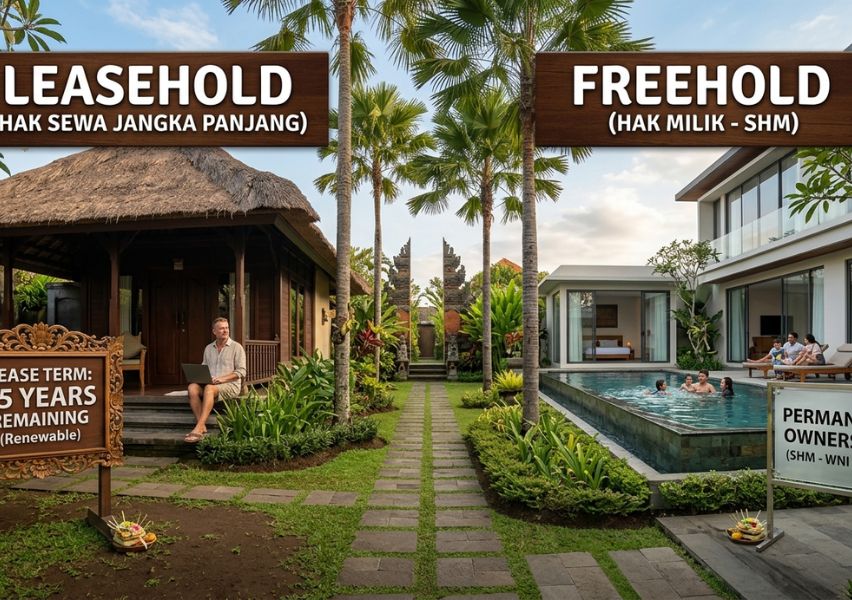

Investing in a villa in Bali is often presented as an attractive source of passive income, with the potential for high returns on investment (ROI). Images of luxurious villas with private swimming pools and scenic views in Canggu, Seminyak, Uluwatu, and Ubud encourage many investors to put their money into the Bali property market.
However, behind the promising rental income projections lie various hidden costs that are often overlooked in the initial budget. Without proper financial planning, these expenses can significantly reduce your villa's profit margins.
As a professional Bali villa management provider, The Loka Management Villa has compiled 17 hidden costs associated with investing in a villa in Bali, along with strategies to help you manage them and maintain healthy cash flow.
Legal and Compliance Costs
Many investors focus primarily on land prices and construction costs, overlooking the additional expenses involved in meeting legal and regulatory requirements in Bali.
1. Notary and Legal Consultancy Fees
Arranging leasehold agreements, freehold property transactions, or establishing a foreign-owned company (PT PMA) requires the services of local notaries and legal consultants. Fees may range from 1% to 2% of the transaction value, depending on the complexity of the arrangement.
2. Building Approval (PBG) and Certificate of Proper Function (SLF)
The Building Approval (Persetujuan Bangunan Gedung or PBG) and Certificate of Proper Function (Sertifikat Laik Fungsi or SLF) are important regulatory requirements for buildings in Indonesia. Obtaining these documents may involve additional technical assessments and independent architectural consultancy fees.
Investors should ensure that their villa meets the applicable requirements before operating it as a commercial rental property.
3. Tourism Accommodation Licensing and PBUMKU
Operating a villa as a short-term rental requires the appropriate business licensing and accommodation classifications under applicable Indonesian regulations. Depending on the business structure and property classification, this may involve PBUMKU (Perizinan Berusaha untuk Menunjang Kegiatan Usaha) or other relevant licensing requirements.
Administrative, certification, and professional consultancy fees should be included in the initial investment budget.
4. VAT on Self-Constructed Buildings (KMS)
If you construct a villa independently rather than purchasing a completed property, you may be subject to VAT on Self-Constructed Buildings (Kegiatan Membangun Sendiri or KMS), depending on the applicable tax rules and eligibility criteria.
Under the applicable calculation method, the effective VAT rate may be 2.4% of the relevant construction cost base. Investors should confirm the current requirements and calculation with a qualified tax consultant before starting construction.
Operational and Utility Costs
Once your villa begins operating, monthly expenses extend far beyond ordinary household electricity and water bills.
5. Commercial Electricity Capacity and High Energy Consumption
Commercial villas equipped with multiple air-conditioning units, swimming pool pumps, water heaters, and outdoor lighting require substantial electricity capacity. Depending on the villa's size and facilities, the required capacity may start at 7,700 VA and exceed 11,000 VA.
High energy consumption can significantly increase monthly operating expenses. Electricity tariffs also depend on the applicable customer category and tariff regulations, so investors should verify the relevant rate rather than assume all commercial properties pay the same tariff.
6. Water Treatment and Septic Tank Maintenance
In some areas of Bali, including parts of Uluwatu and Pererenan, access to reliable piped water may be limited. Villa owners may need to purchase water from tanker suppliers or invest in bore wells and water filtration systems.
Septic tank inspections, desludging, and wastewater treatment also require periodic maintenance. These costs can increase substantially during periods of high occupancy.
7. Waste Collection and Community Fees
Commercial villas generate more waste than typical residential properties, particularly during peak tourist seasons. Owners may need to arrange private or community-based waste collection services and pay local community contributions or banjar fees.
These recurring expenses should be included in the monthly operating budget.
8. Frequent Linen and Towel Laundry
Hotel-quality bed sheets and towels require regular professional laundering to maintain cleanliness, softness, and presentation standards.
Laundry expenses fluctuate with occupancy levels, guest turnover, and the number of linen changes required. During busy periods, these variable costs can become a significant part of the operating budget.
Maintenance and Replacement Reserves
Bali's tropical climate, high humidity, heavy rainfall, and coastal salt exposure can accelerate wear and tear on villa buildings, furniture, and equipment.
9. Swimming Pool Maintenance and Chemicals
Swimming pools require regular cleaning, chemical balancing, filter maintenance, and pump inspections to maintain water quality and guest safety.
Expenses may include chlorine or salt, balancing chemicals, cleaning equipment, and professional pool maintenance services. Depending on usage and weather conditions, maintenance may be required several times a week.
10. Pest Control
Termites, rodents, mosquitoes, and other tropical insects are common concerns for properties in Bali. Regular professional pest control helps protect wooden structures, maintain hygiene, and provide a comfortable environment for guests.
Preventive treatments are generally more cost-effective than dealing with extensive infestations or structural damage.
11. Repairs Caused by Tropical Weather and Salt Air
Leaking roofs during the rainy season, deteriorating wooden structures, and corrosion affecting air-conditioning units or outdoor barbecue equipment can lead to unexpected repair bills.
Villa owners should establish a dedicated maintenance reserve or sinking fund to cover major repairs and replacements. A preliminary reserve of 3%–5% of monthly revenue may serve as a budgeting reference, although the appropriate amount depends on the property's age, construction quality, location, and maintenance history.
12. Replacement of Operating Supplies and Equipment (OS&E)
Broken glasses, chipped plates, stained towels, damaged bed sheets, and other guest-related wear and tear are routine expenses in villa operations.
Operating Supplies and Equipment (OS&E) must be replenished regularly to maintain service standards. Although individual items may seem inexpensive, replacement costs can accumulate over time, particularly in villas with high occupancy and frequent guest turnover.
Marketing and Distribution Costs
Generating bookings does not happen automatically. Reaching potential guests and maintaining a competitive position in Bali's accommodation market require ongoing investment.
13. Channel Manager and Online Travel Agency (OTA) Commissions
Platforms such as Airbnb, Booking.com, and Agoda may charge commissions or other fees on bookings, depending on their respective fee structures and agreements.
For planning purposes, investors may use an estimated range of 15%–20% of the booking value, but actual charges vary by platform, property, and payment arrangement.
These fees can significantly affect net revenue, making it important to account for distribution costs when setting room rates and evaluating profitability.
14. Payment Gateway and Credit Card Transaction Fees
Direct bookings can reduce dependence on online travel agencies, but they may still incur payment processing fees.
International credit card payments, online payment gateways, and cross-border transfers can involve transaction fees, currency conversion charges, and foreign exchange spreads. Depending on the provider and payment method, processing fees may range from approximately 2.5% to 4% or more.
Investors should compare payment providers and account for these costs when calculating net booking revenue.
15. Professional Photography, Videography, and Digital Advertising
High-quality visual assets are essential for attracting potential guests in Bali's competitive villa rental market.
Professional architectural photography, drone videography, and paid advertising through platforms such as Meta Ads and Google Ads all require dedicated marketing budgets.
These investments help improve a villa's online presentation, increase visibility, and support direct booking strategies. However, marketing expenses should be evaluated against actual booking performance and acquisition costs.
Taxes and Community Contributions
Understanding local tax obligations and community expectations is essential to maintaining compliance and avoiding unexpected liabilities.
16. Regional Tax on Certain Goods and Services (PBJT)
Accommodation businesses may be subject to the regional tax on certain goods and services, commonly referred to as PBJT, under Indonesia's regional tax framework.
For hotel and accommodation services, the applicable rate can be up to 10%, depending on the relevant regional regulations and classification. The tax treatment and applicable rate should be confirmed with the local tax authority.
Where applicable, accommodation businesses must collect, report, and remit the tax in accordance with the relevant requirements. Investors should distinguish between taxes collected from guests and the property's own operating expenses when calculating profitability.
17. Banjar Contributions and Local Ceremonial Expenses
Community relationships are an important part of operating a villa in Bali. Depending on local customs and arrangements, owners or operators may be asked to contribute to religious ceremonies, community activities, and traditional events in the surrounding banjar.
These contributions can vary by location and circumstance. Building good relationships with the local community and understanding local expectations early can help investors plan more effectively and support harmonious long-term operations.
How to Manage Hidden Costs in Your Bali Villa Investment
Managing all these expenses independently can be time-consuming and may lead to inaccurate budgeting, inefficient vendor arrangements, or missed compliance requirements.
This is where professional villa management can make a difference.
The Loka Management Villa provides professional Bali villa management services designed to help property owners manage operations efficiently, maintain transparency, and protect their investment returns.
Our services help investors through:
1. Operational Cost Efficiency
We work with trusted local vendors to manage maintenance, pest control, and operating supplies while seeking competitive rates and maintaining service standards.
2. Dynamic Pricing Strategies
We consider market demand, seasonal occupancy, operating expenses, and booking channel commissions when developing pricing strategies to help protect profit margins and improve revenue potential.
3. Legal Compliance and Community Relations
We help coordinate relevant operational requirements and maintain positive relationships with the local community, supporting smoother day-to-day villa operations.
Protect Your Bali Villa Investment with Professional Management
A villa's rental revenue does not automatically translate into profit. Legal requirements, utility bills, maintenance, distribution commissions, taxes, and community contributions can all affect your actual return on investment.
Understanding these hidden costs before investing allows you to build a more realistic financial forecast, maintain healthy cash flow, and make better long-term decisions.
Don't let overlooked expenses reduce the potential of your investment.
Contact The Loka Management Villa today to discuss professional villa management in Bali and discover how a transparent, well-planned management strategy can help you make the most of your property investment.